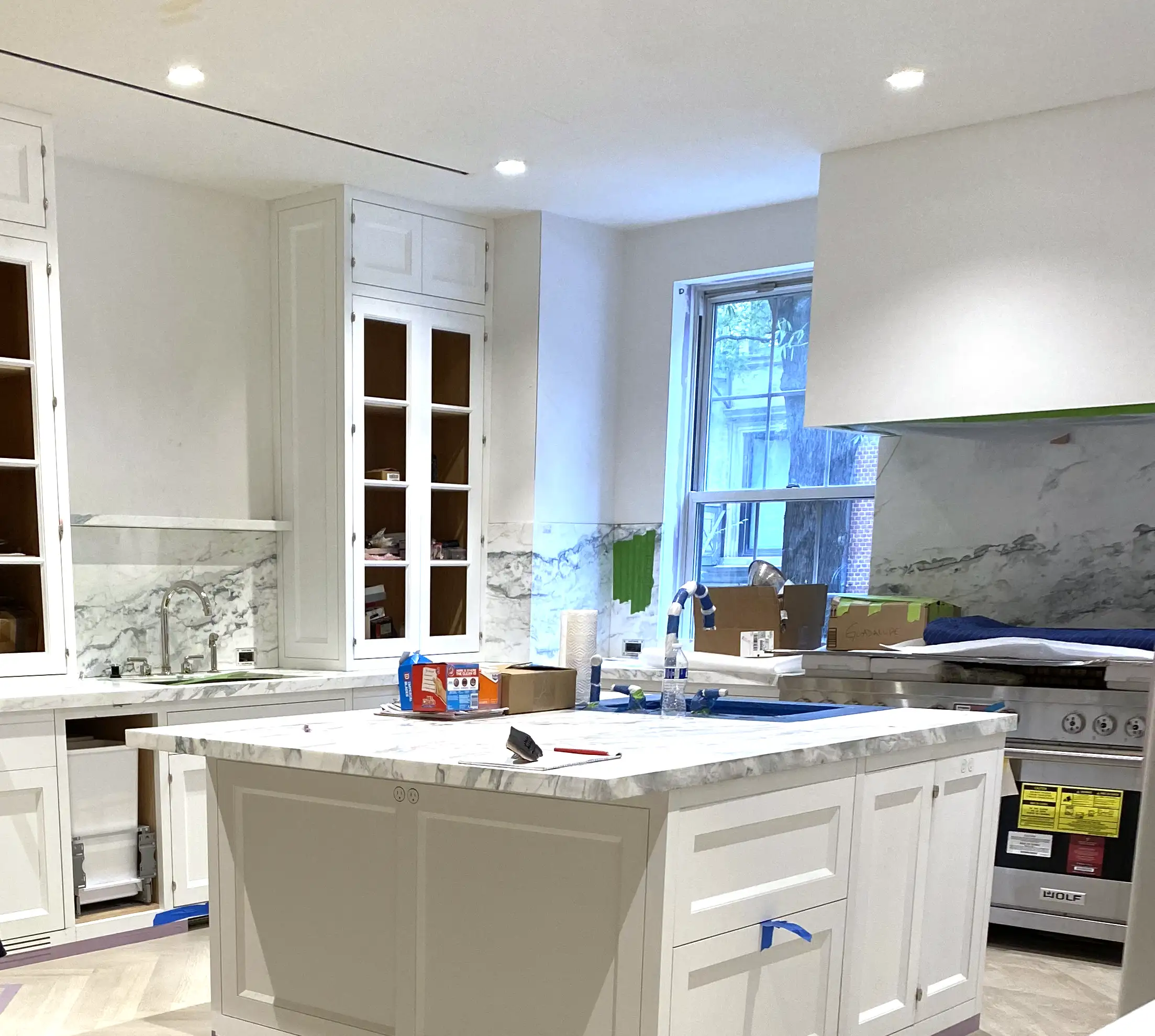
Pre-war New York co-op millwork is not standard residential millwork with taller ceilings. The buildings impose a specific set of constraints — structural, physical, administrative, and environmental — that require adjustment at every stage of the specification process. Most of these constraints are not visible during the initial site visit. All of them are legible to a workroom that has executed pre-war work consistently.
Ceiling heights and proportional rules
Pre-war buildings typically run 9'6" to 11' clear ceiling heights in living and dining rooms, with service areas and secondary rooms at 8'6" to 9'. The additional height is an advantage that immediately creates a problem: standard upper-cabinet proportions derived from 8-foot ceiling work look compressed in these rooms. A kitchen with 42-inch uppers at an 11-foot ceiling has 90 inches of exposed wall above the counter line. The solution is not to make the uppers taller — it is to proportion the entire millwork elevation to the room, treating the ceiling as the datum rather than standard industry dimensions. This requires a measured drawing of the room before any millwork layout begins.
Plaster walls
Pre-war walls are hard plaster on metal lath, not drywall. The implications for millwork are practical. Scribing is harder — plaster is brittle and does not compress under pressure the way drywall will. Wall irregularities in pre-war buildings are larger and less predictable, because plaster walls shift with the building over a century. Standard scribe allowances of ¼" to ½" are often insufficient. We typically take wall readings at 12-inch vertical intervals across any wall receiving millwork and design the scribe profile from measured data rather than assumptions.
Elevator constraints
Pre-war service elevators typically run 36" × 60" to 42" × 72" interiors. This is the physical constraint that governs how millwork is cut. Any case that cannot be broken down to pass through the elevator cannot reach the apartment — stair access is rarely an option for pieces over 200 pounds. Break-point engineering — pre-planned seams that allow large pieces to be assembled on-site — is not optional in most pre-war buildings. It must be designed into the shop drawings, not improvised on delivery day.
Building board approvals
Most pre-war co-ops require board approval for renovation work. The relevant detail for millwork: alteration agreements typically require submission of design drawings, not just construction drawings. A floor plan showing cabinet footprints is not sufficient. Elevation drawings showing full-height millwork, with materials and finishes called out, are typically required by the managing agent before a work permit is issued. Budget for this drawing set at the start of the project, not as a reactive expense.
Seasonal movement
Pre-war buildings move. The buildings are not tightly sealed, HVAC systems are not always zoned, and relative humidity in these apartments swings substantially between summer and winter. Solid-wood panel specifications must account for this movement: floating panels in frames, not glued. Species selection matters — quartersawn and riftsawn cuts move significantly less across the width than plain-sawn cuts. A specification that performs well in October can fail by March if movement is not accounted for in the design.
The practical summary
Before specifying millwork in a pre-war building: measure the elevator, read the alteration agreement, take wall readings before layout, proportion the elevation to the room rather than to standard cabinet dimensions, and specify solid wood elements for movement, not against it. Most problems that surface during pre-war millwork installation are legible in the drawings if you know what to look for.
The full range of New York building typologies and their constraints is documented in the spatial systems reference.