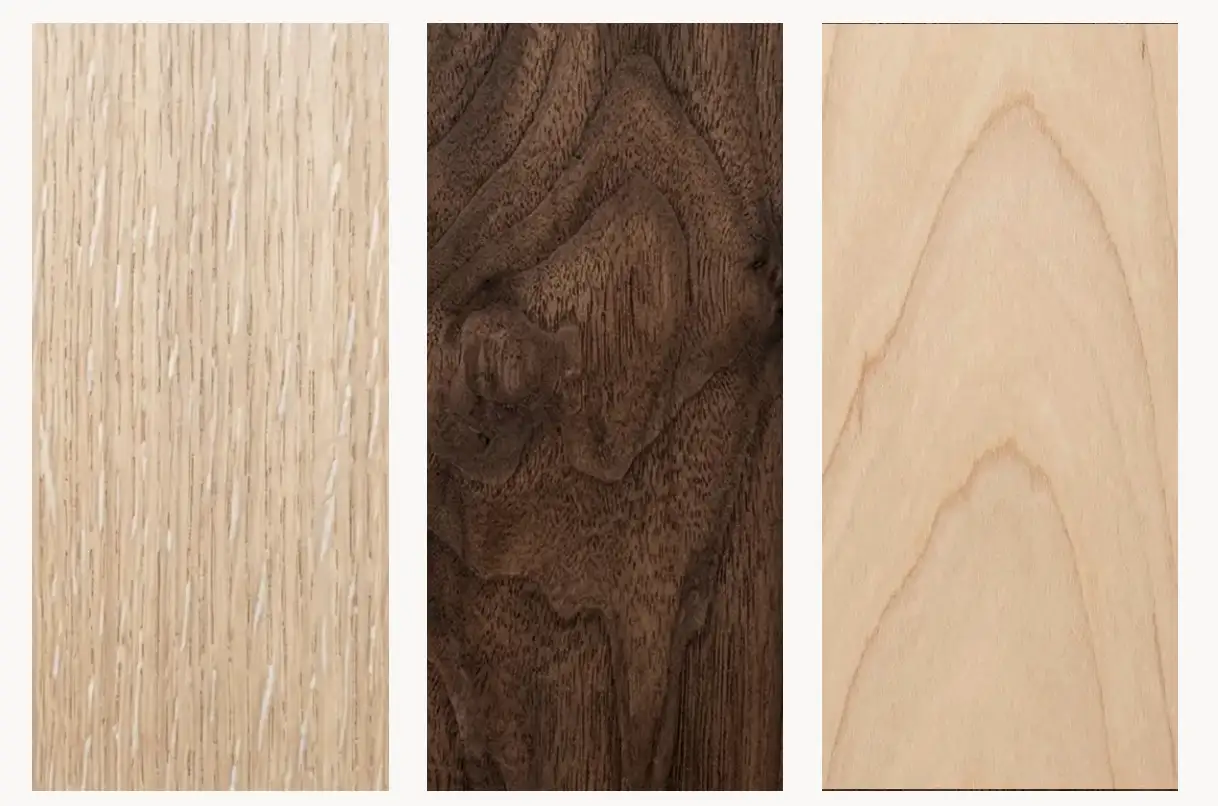
A solid wood panel and a veneered panel are different things, and they are appropriate for different applications. Solid wood moves with humidity — it expands and contracts across the grain as moisture content changes. In a New York apartment that swings from 20% relative humidity in January to 70% in August, solid wood panels wider than about five inches will move measurably. A solid wood cabinet door in this environment will rack, stick, and gap across the seasons unless it is designed specifically to accommodate the movement.
Veneered construction — a thin face of the desired wood species applied to a stable substrate, typically MDF or veneer-core plywood — solves the movement problem. The substrate does not move. The face moves with it. The result is a panel that holds its dimensions and flatness across seasonal humidity cycles.
But veneered construction introduces a decision that solid wood does not: sequence.
A veneer face is cut from a flitch — the sequential slices from a single log, numbered in order. How those slices are arranged across a surface is a design decision that determines whether the finished panel reads as coherent or arbitrary.
Book-matching places adjacent slices face-to-face, producing a mirrored grain pattern across the seam. It is formal and symmetrical — appropriate for a library panel or cabinet door where the mirror becomes a feature. Slip-matching places adjacent slices in the same orientation, producing a repeating grain that reads as more casual. Running-match uses whatever comes off the flitch in order — common in production work where cost drives decisions.
The choice between these methods is not inherently right or wrong. But it is a choice, and it should be made deliberately. A book-matched veneer panel on a kitchen cabinet door looks formal in a way that may not suit a contemporary kitchen. A slip-matched panel on a library bookcase may read as too casual for the room's register.
We specify veneer sequence at the same time as species and cut. The materials and specification reference covers wood species selection, cutting methods, and substrate engineering in detail — including how rift and quartersawn cuts interact with match patterns to produce different visual results.
The most common mistake in millwork specification is treating the veneer as a material choice — species and finish — without specifying how it is arranged. The species determines the color and figure range. The sequence determines what the surface actually looks like.