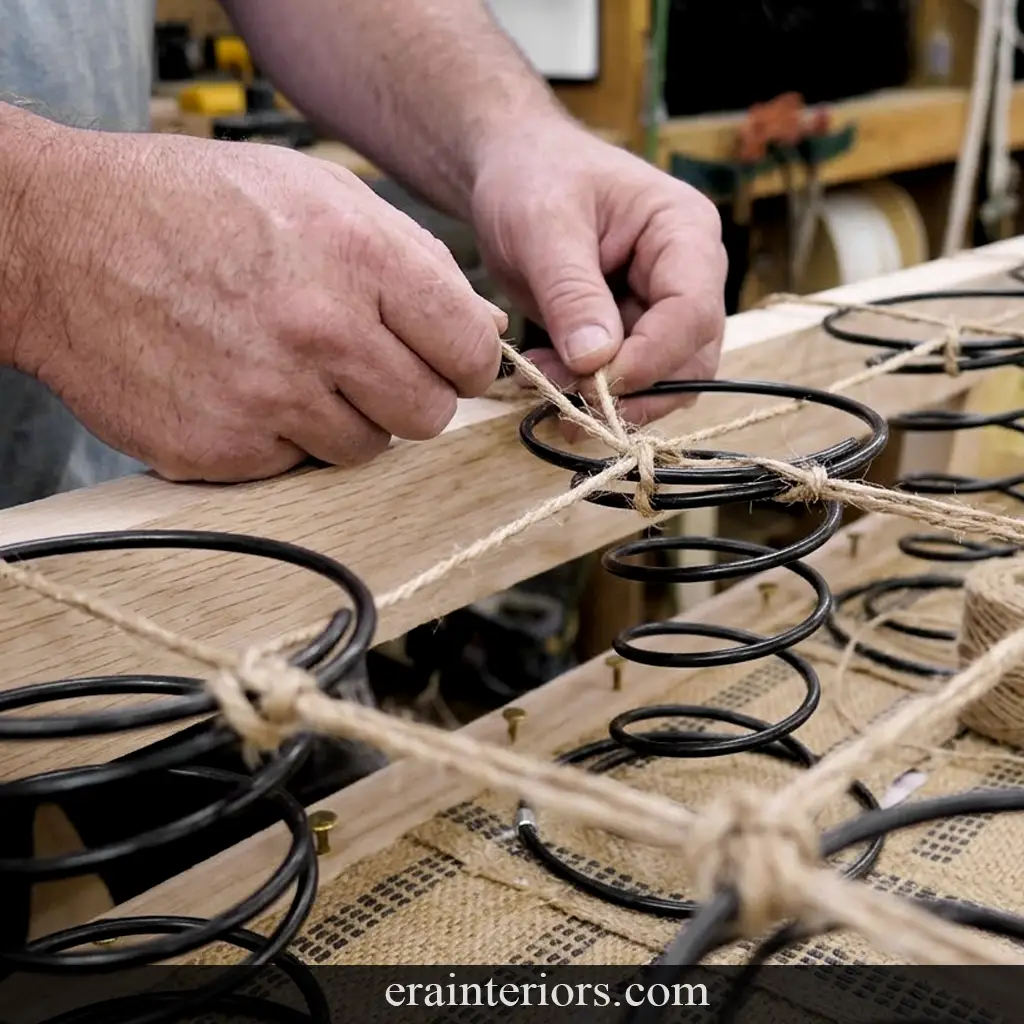
Eight-way hand-tied is a spring suspension system in which individual coil springs are set into a webbed base and tied to adjacent springs — and to the frame — using jute or polypropylene cord at eight points: four cardinal directions and four diagonals. Each spring is knotted independently, producing a load-sharing network rather than a rigid grid. The result is a seat that distributes weight continuously, returns to its original profile after compression, and does not develop the hard spots or sag lines common to inferior systems.
The alternative systems — sinuous wire springs and drop-in spring units — are not inferior because they are less expensive. They are inferior because they are structurally independent of each other. A sinuous spring is a single continuous S-shaped wire spanning from front rail to back rail. It flexes well but does not share load with the spring next to it. When one wire fatigues, that section of the seat fails while adjacent sections remain intact, creating the characteristic uneven wear visible in mid-grade upholstery after five to seven years. Drop-in spring units are pre-assembled sinuous or pocket-coil modules that simply drop into the frame — quick to install, impossible to repair in place. Both systems are entirely appropriate for furniture with a planned service life of under ten years. They are not appropriate for the work we do.
Cost and lead time
Eight-way hand-tied adds labor. On a standard two-cushion sofa, the spring-tying operation alone takes a skilled upholsterer three to four hours. When you are comparing proposals, a fully eight-way hand-tied sofa will run $800 to $1,500 more in labor than the same piece built on sinuous springs, depending on the shop's labor rate and the complexity of the seat profile. This is a number worth knowing before you specify.
How to verify it
A finished piece will not let you see the suspension directly, but you can verify it at delivery in two ways. First, press firmly into the seat in three locations: near the front rail, in the center, and near the back. On a well-tied piece, resistance is consistent and the adjacent seat areas respond slightly — because the springs are connected and share load. On a sinuous-spring piece, resistance varies significantly and adjacent areas do not respond. Second, ask the workroom to provide the shop drawing or cut sheet before fabrication. Reputable shops producing eight-way hand-tied work will document the spring count, cord type, and tying pattern. If that documentation is not available, the system is likely sinuous.
When to specify it
For any piece intended to be in use for more than ten years, eight-way hand-tied is the correct specification. This includes sofas, upholstered chairs in primary seating positions, settees, and any piece that will see daily use by multiple occupants. It is not necessary for decorative chairs with limited occupancy, accent seating, or pieces where the fabric rather than the longevity is the primary specification concern.
The spring suspension is the first decision in the foundation specification — before fill, before fabric, before any visible element of the piece. It is also the decision that is most difficult to reverse. Getting it right at the specification stage costs $1,000. Getting it wrong costs the price of the piece.
The structural logic behind eight-way hand-tied spring systems is covered in detail in the frame and foundation reference.