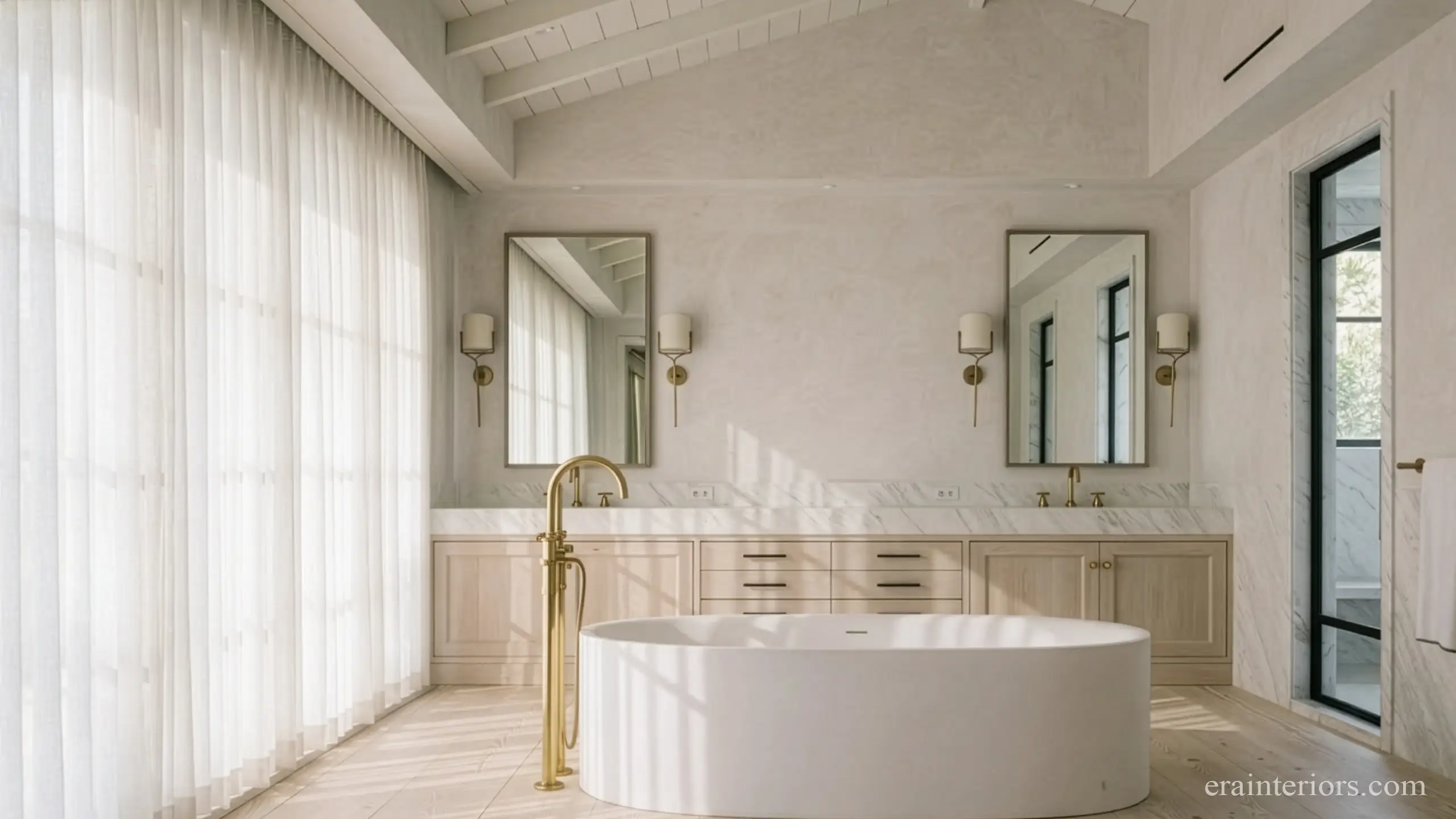
When millwork and soft furnishings are commissioned from the same atelier, the specification decisions that govern both disciplines happen in the same conversation. The wood species, the finish, the hardware, the fabric palette, the drapery heading — these decisions are made in relation to each other rather than independently. This changes the outcome.
**The problem with separate commissioning**
A kitchen specified by a millwork shop and a drapery program specified by a soft furnishings workroom will produce two technically competent results. What they will rarely produce is a room that reads as a single thing. The linen selected for the drapery may work with the fabric on the banquette and against the tone of the oak on the cabinetry. The hardware finish on the cabinet pulls and the hardware on the drapery pole may be close but not matched. The reveal dimension on the cabinet face frame and the border on the headboard may both be well-resolved within their own logic and slightly off relative to each other.
None of these misalignments is catastrophic. Taken together, they produce a room that is very good rather than excellent — and in a residence at this level, that gap is the entire margin.
**What a compound program actually means in practice**
In our compound programs, the specification conversation begins before any drawings. The client, the architect or designer if one is involved, and our team review the full scope — every millwork room and every soft furnishings piece — as a single program. The decisions made early (species, finish, hardware finish, fabric register, drapery system) become constraints that all subsequent decisions are made against.
This is not complicated design theory. It is the same logic a good tailor applies when making a suit: the lining, the interlining, the shell fabric, and the buttons are all chosen in relation to each other. The suit reads as a suit rather than as four separate material decisions.
**The projects where this matters most**
The compound program approach produces its highest returns on full-floor apartment renovations, townhouse programs, and estate commissions where the scope spans multiple rooms and both disciplines. A kitchen and a drapery program in a single room is one thing. A program that includes a kitchen, a library, a primary suite, a dressing room, and a full soft furnishings program across eight rooms is another — and it is the kind of program where a shared specification vocabulary becomes the difference between a very good interior and a great one.
Our Buildings & Projects collection documents six compound commissions in detail. The Soft Furnishings Projects collection documents the soft furnishings side of the same work. Several projects appear in both — the Central Park South and West Village commissions are among the clearest examples of what the compound program produces when the scope is large enough to show its logic fully.
Related: When the Sofa and the Millwork Are the Same Project · The Headboard Is Not Separate From the Room · Architectural Soft Furnishings