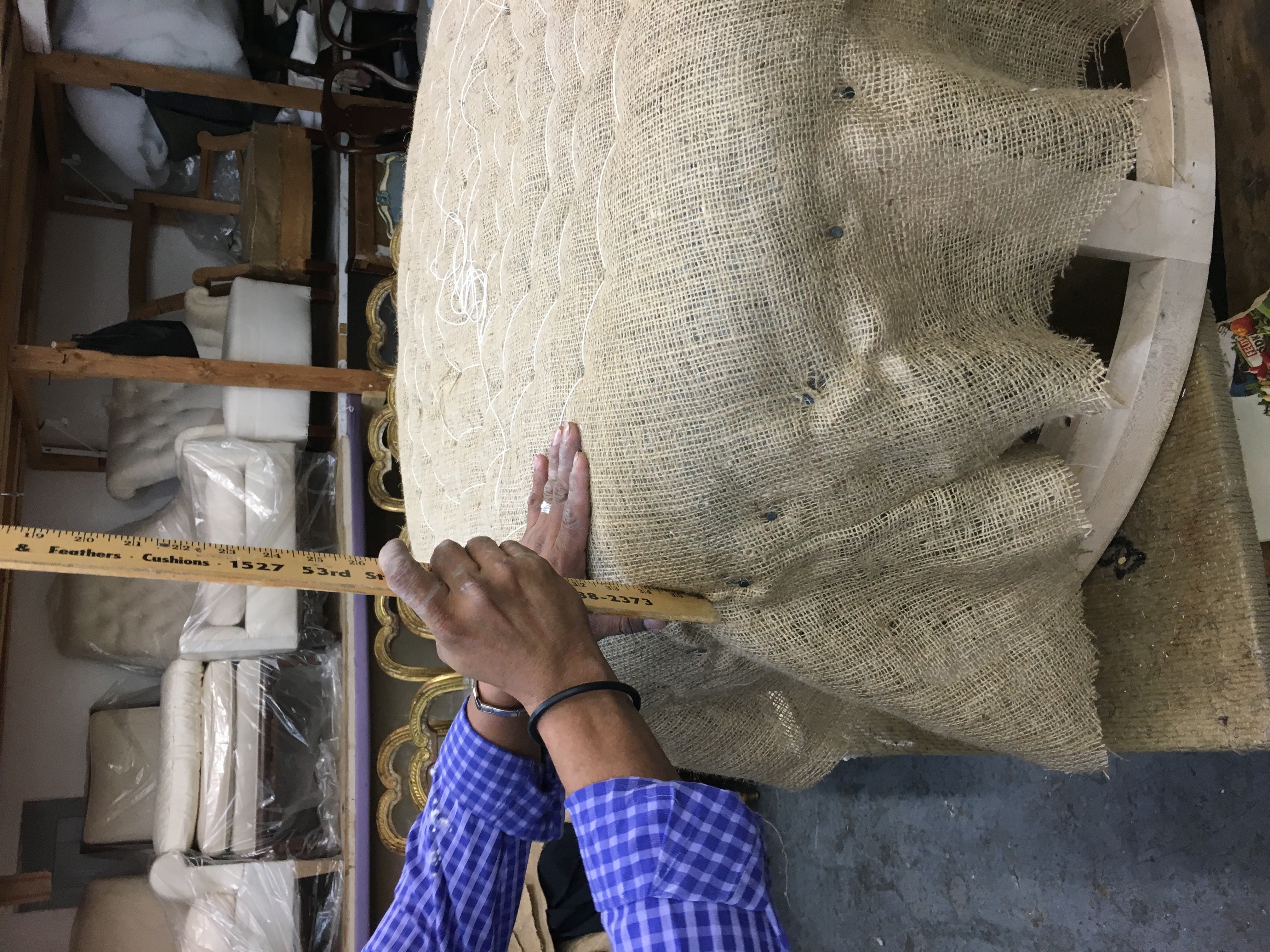
Most clients who commission a custom sofa specify two things: the fabric and the profile. The fabric because it is the most visible decision. The profile because it is the visual identity of the piece.
These are real decisions. They are also the last decisions. The fill system — the layered structure between the frame and the face fabric — is the decision that determines how the piece performs over its life. And it is rarely discussed.
The fill system works from the inside out. A high-quality residential seat cushion is built in sequence: a core of high-resilience foam at minimum 1.8 lb/ft³ density and 35 ILD for a seat cushion, enclosed in a down-proof ticking, wrapped in a dacron layer for softness at the edges, with a down-and-feather comfort layer inside the ticking at 85/15 down-to-feather minimum. The core provides the structural support and recovery. The dacron wrap gives the cushion its rounded, dressed silhouette — the gentle fullness at the corners that distinguishes a properly made cushion from a foam block in a slipcover. The down comfort layer gives the initial softness at first contact.
A cushion built this way returns to its shape in under a second after compression. After three years of daily use, it is indistinguishable from its initial state. After ten years, it still performs.
A production sofa cushion is typically a compressed foam block at 1.5 lb/ft³ or lower, often in a polyester slipcover, with no dacron wrapping and no down layer. It feels acceptable in the showroom. Within a year, the foam has compressed and the edges have collapsed. Within three years, the seat is visibly degraded.
The frame and foundation reference covers suspension systems, frame construction, and the complete fill system specification — including foam density and ILD grades, down fill ratios and fill power, ticking specifications, and dacron wrapping. The fill, fabric, and material specification covers the complete material vocabulary of a soft furnishings program.
The fill system is invisible. No photograph shows it. It is entirely possible to commission a custom sofa in a beautiful fabric on a well-proportioned frame with a fill system that will fail in two years — and have no indication of this from anything visible at the point of purchase. This is where the performance life of a piece is won or lost. Usually without the client knowing until it is too late.