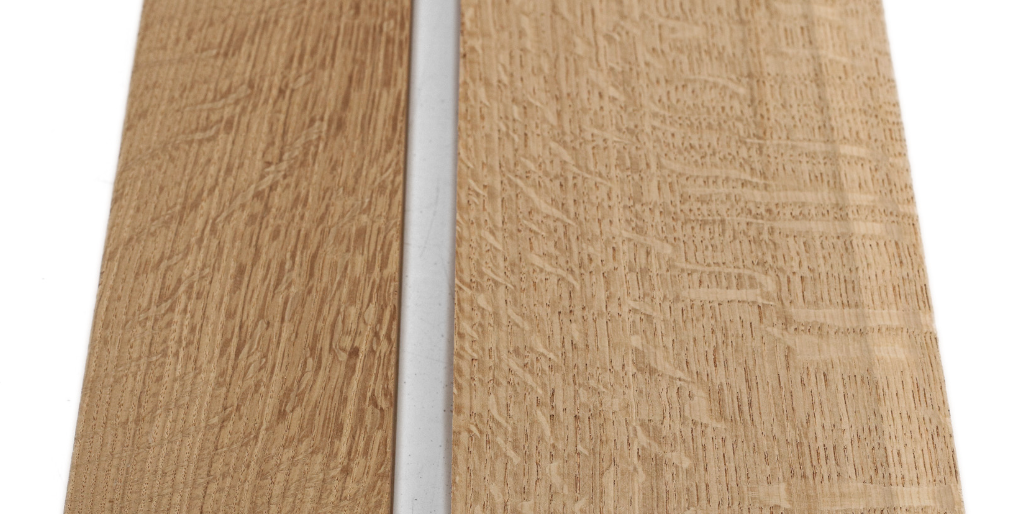
The way a log is sliced determines what the wood looks like, how it moves, and how long it holds its shape. The difference between flatsawn and quartersawn lumber from the same species can be dramatic — different grain pattern, different figure, different dimensional behavior across seasonal humidity changes. In New York, the cutting method is a specification decision with real performance consequences.
Flatsawn lumber — the default, because it yields the most material from a log — is cut with the growth rings running roughly parallel to the face of the board. The result is the cathedral grain pattern: arching, figure-rich, visually active. Flatsawn boards are wide, available, and relatively inexpensive. They are also the least dimensionally stable cut. A wide flatsawn panel in a dry New York winter will shrink. In a humid summer, it will expand. Designed for this movement, it performs. Ignored, it causes problems.
Quartersawn lumber is cut with the growth rings running roughly perpendicular to the face. The resulting grain is straight and consistent — tight parallel lines rather than arching cathedral. Quartersawn white oak produces the characteristic ray fleck that is one of the most beautiful grain patterns in domestic hardwood. Quartersawn boards are narrower, more expensive, and harder to find in wider widths. They are also dramatically more stable — moving half as much across their width compared to flatsawn material from the same species.
Rift-sawn lumber falls between the two: the growth rings are at roughly 45 degrees to the face. The result is the straightest, most consistent grain pattern of the three cuts — no cathedral, no ray fleck, just clean parallel lines. Rift is the appropriate specification for contemporary millwork where visual consistency is the priority and figure is a distraction. It is also more expensive and produces more waste per log.
The cutting method interacts with species, application, and finish in ways that affect both appearance and performance. The materials and specification reference covers species selection, cutting methods, and substrate engineering — including how these decisions interact with veneer sequence and match pattern.
We default to rift and quartersawn for primary surfaces in any New York installation where dimensional stability matters. Flatsawn material has appropriate uses — certain traditional applications, situations where the cathedral grain is specifically desired — but it is not our default for Manhattan apartments. The humidity argument alone is sufficient. The stability argument makes it definitive.