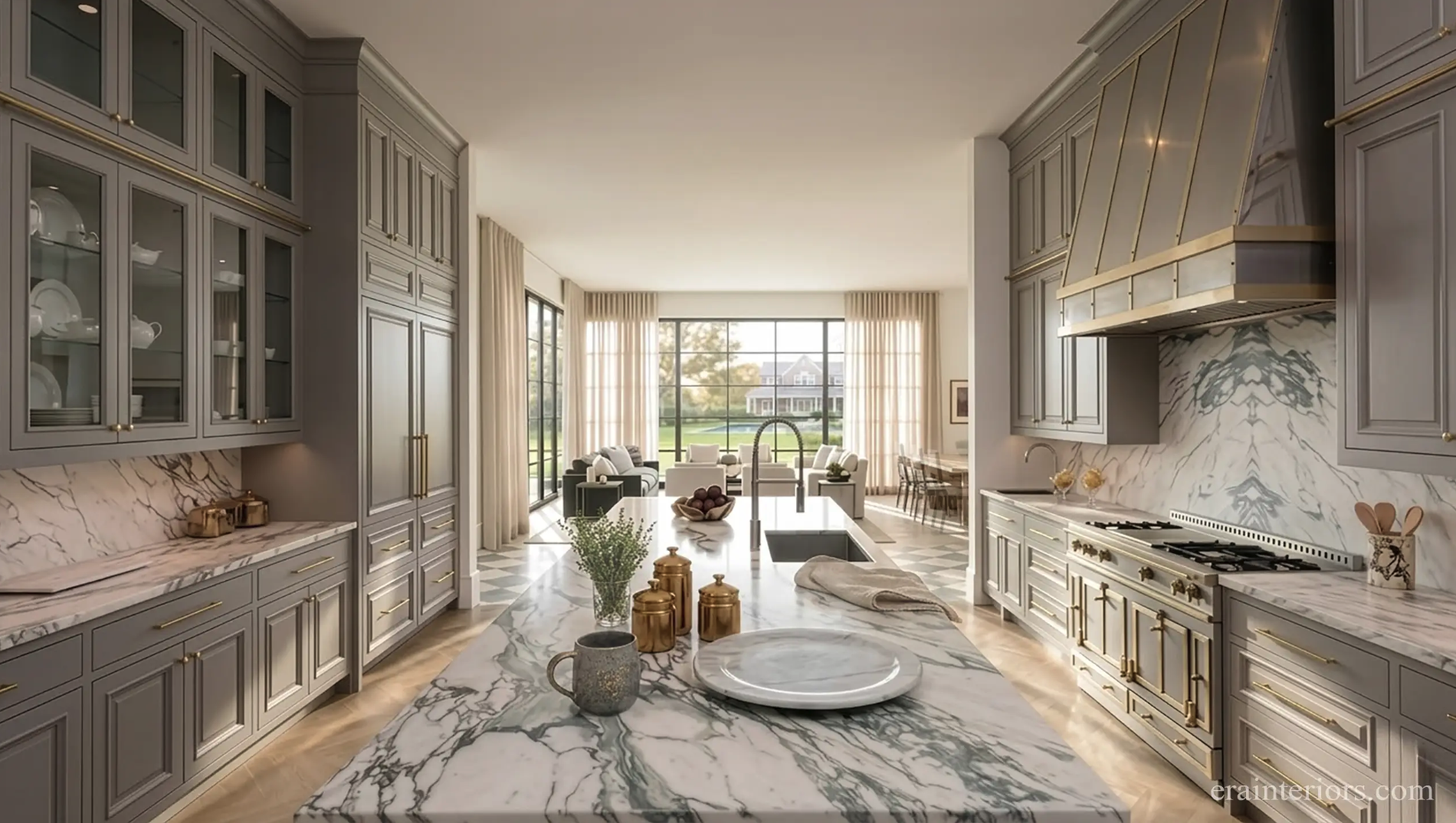
A Hamptons estate commission is not a Manhattan apartment commission with more square footage. The building conditions, the client relationship, the installation logistics, and the material decisions are all different — and the millwork specification needs to account for all of them from the first drawing.
**The building conditions are not pre-war constraints. They are coastal ones.**
Manhattan millwork is largely governed by building access: service elevator dimensions, alteration agreement windows, co-op board approval timelines. Hamptons millwork is governed by different variables — humidity fluctuation between seasons, the gap between how a house is occupied in July and how it sits in February, and the reality that a shingle-style house built in 2004 and a Victorian cottage built in 1895 occupy the same market and often the same street.
Humidity is the primary material variable. Wood moves. In a house that swings from 80% relative humidity in August to 20% in a heated but lightly occupied February, the movement in a solid wood panel or a face-frame door can be significant enough to cause binding, gapping, or finish failure. The specification response is not to avoid wood — it is to select species and construction methods appropriate to the environment. Quartersawn lumber moves less than flatsawn. Veneered substrate over engineered core moves less than solid. Hardware tolerances need to account for seasonal variation.
**The kitchen is usually the anchor scope — but rarely the whole project.**
In our experience, Hamptons commissions that begin with a kitchen inquiry tend to expand. The client working on a shingle-style house in East Hampton or a converted barn in Sagaponack also has a pool house, a mudroom, a butler's pantry, a bar room, and five bedroom closets. The scope grows not because the client is being upsold — it is because the house has the rooms and the client has the budget, and once a fabricator they trust is on the property, the logic of doing it all together becomes obvious. We have seen this dynamic on estates in Bridgehampton and Southampton as readily as in the village itself.
This is the compound program dynamic in its most natural form. The kitchen palette — a species, a finish, a hardware family — becomes the governing language for every other millwork room in the house. Soft furnishings follow the same logic: a drapery program specified against the millwork palette, rather than independently, reads as a single interior rather than a collection of separate decisions.
**Installation logistics require more planning than a Manhattan project.**
Our crew travels for Hamptons installations. A project that might be phased across three co-op-compliant windows in Manhattan becomes a single extended installation run on the East End. That changes how we fabricate — everything needs to be complete and quality-checked before it leaves Brooklyn, because there is no easy return trip for a mismatch. Delivery logistics, storage on-site, and crew coordination with other trades all require a higher level of pre-planning than a local installation. For North Fork and Shelter Island commissions, the same applies — the distance and the logistics are part of the spec from day one.
This is not a reason to avoid this work. It is a reason to be explicit about it in the proposal and to build the logistics into the schedule and budget from the start.
For clients and architects working on coastal estate commissions — whether in the Hamptons, Sag Harbor, Montauk, or along the Connecticut shore — we are glad to discuss scope, timeline, and the material decisions specific to the environment. Our compound program approach — millwork and soft furnishings specified together — is particularly well suited to full-house commissions where the interior needs to hold together as a single coordinated program.
Related: Specifying Millwork for Pre-War New York Apartments · The Fill System Is the Furniture · Materials Specification