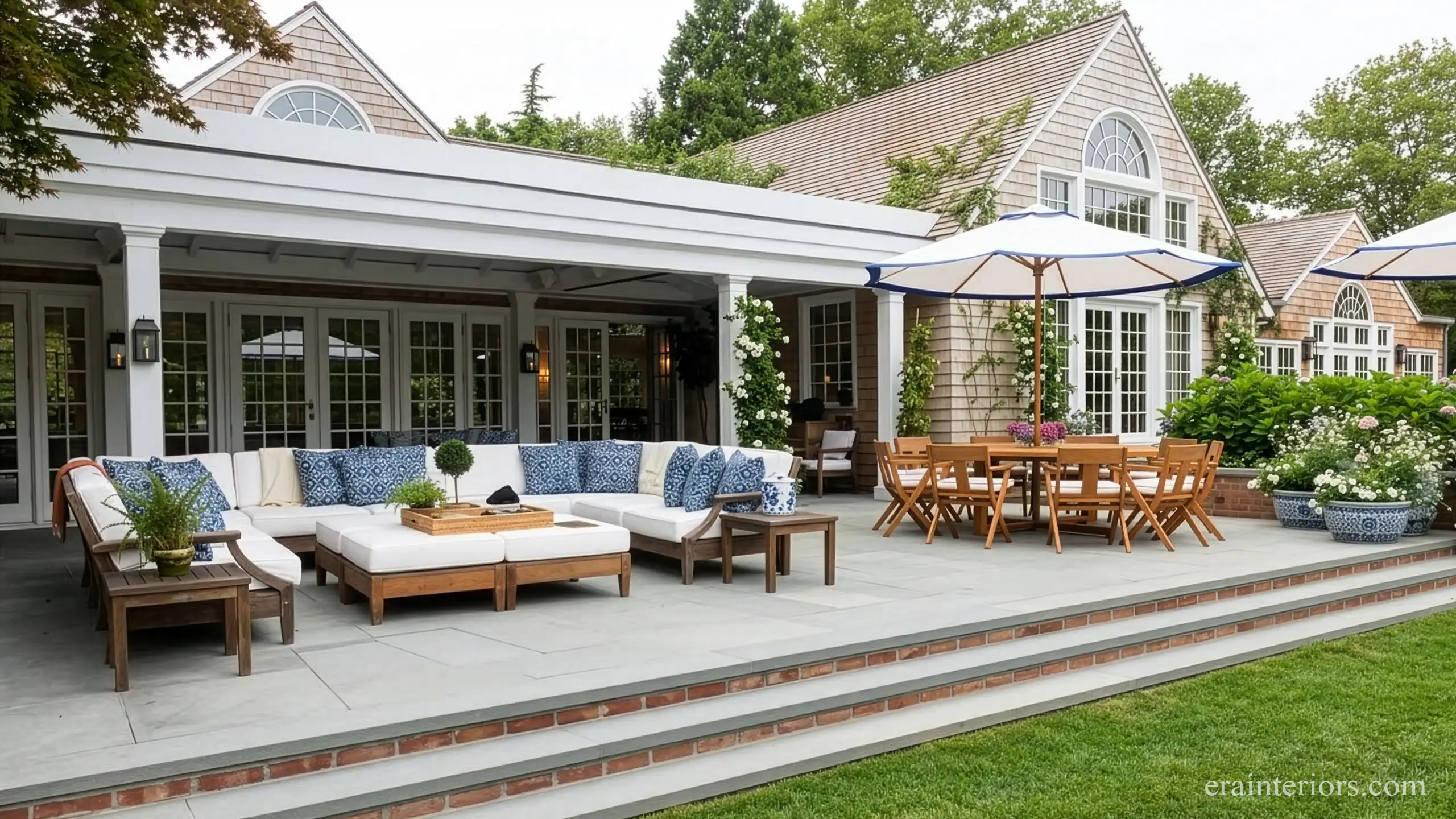
A drapery program for a Hamptons estate, a coastal Connecticut house, or a New Jersey Shore residence requires a different specification approach than a Manhattan apartment. The light is different, the humidity is different, the occupancy pattern is different, and the window conditions are different. A specification that ignores these variables will produce a drapery program that looks right when installed and degrades faster than it should.
**Light and UV exposure**
Coastal properties receive more direct sunlight than Manhattan apartments, and the light changes more dramatically across the day. South and west exposures in a Hamptons house can receive five to six hours of direct sun in summer — enough to fade an unprotected fabric in a single season. UV degradation is not a cosmetic issue; it is a structural one. Fabrics fade unevenly, and UV-degraded fibers become brittle before the physical wear of the fabric shows.
The specification response is not to use heavier lining — it is to select fabrics that perform under UV load. Solution-dyed fibers (acrylic, polyester) hold color under UV where natural fibers do not. For clients who insist on natural fiber — linen, cotton, silk — a blackout or dense sateen lining is not optional. The lining protects the face fabric from direct exposure and extends the useful life of the program significantly.
**Humidity and fabric performance**
Coastal humidity fluctuation is the soft furnishings equivalent of what humidity does to wood. Natural fibers absorb moisture — linen and cotton will shift dimensionally in high humidity, which affects the hang of a panel and the geometry of a heading. In a house that swings between summer coastal humidity and dry winter heat, this movement can cause panels to appear uneven or to pull at their headings over time.
Our Climate Fabrication Protocol addresses this directly: in coastal commissions, fill and fabric selections are reviewed for humidity performance before specification is finalized. For drapery, this typically means either a performance-grade linen (tightly woven, heavier weight) or a linen-blend that stabilizes better than a loose open-weave. The heading style is also relevant — goblet pleat holds its geometry better than ripple-fold in variable humidity conditions.
**Occupancy patterns and motorization**
Vacation properties have a specific occupancy problem: the house may sit empty for weeks at a time with the drapes in whatever position they were left. In a Manhattan apartment, the client adjusts their drapery daily. In a vacation house, automated systems make more sense — not for luxury, but for practical management of UV exposure and the appearance of the house during vacancy.
Motorized systems also address a specific Hamptons condition: the large-format window and door openings in shingle-style estates often require panels too heavy to operate comfortably by hand at full stack. A motorized track — surface-mounted or recessed — solves this without visible hardware compromise.
Our Drapery & Window Treatment Systems collection covers heading types, lining specifications, and hardware systems in detail. For coastal commissions specifically, we are glad to discuss the material decisions that govern long-term performance.
Related: Millwork for Hamptons and Coastal Estate Properties · The Martindale Number Is Not Enough · The Fill System Is the Furniture