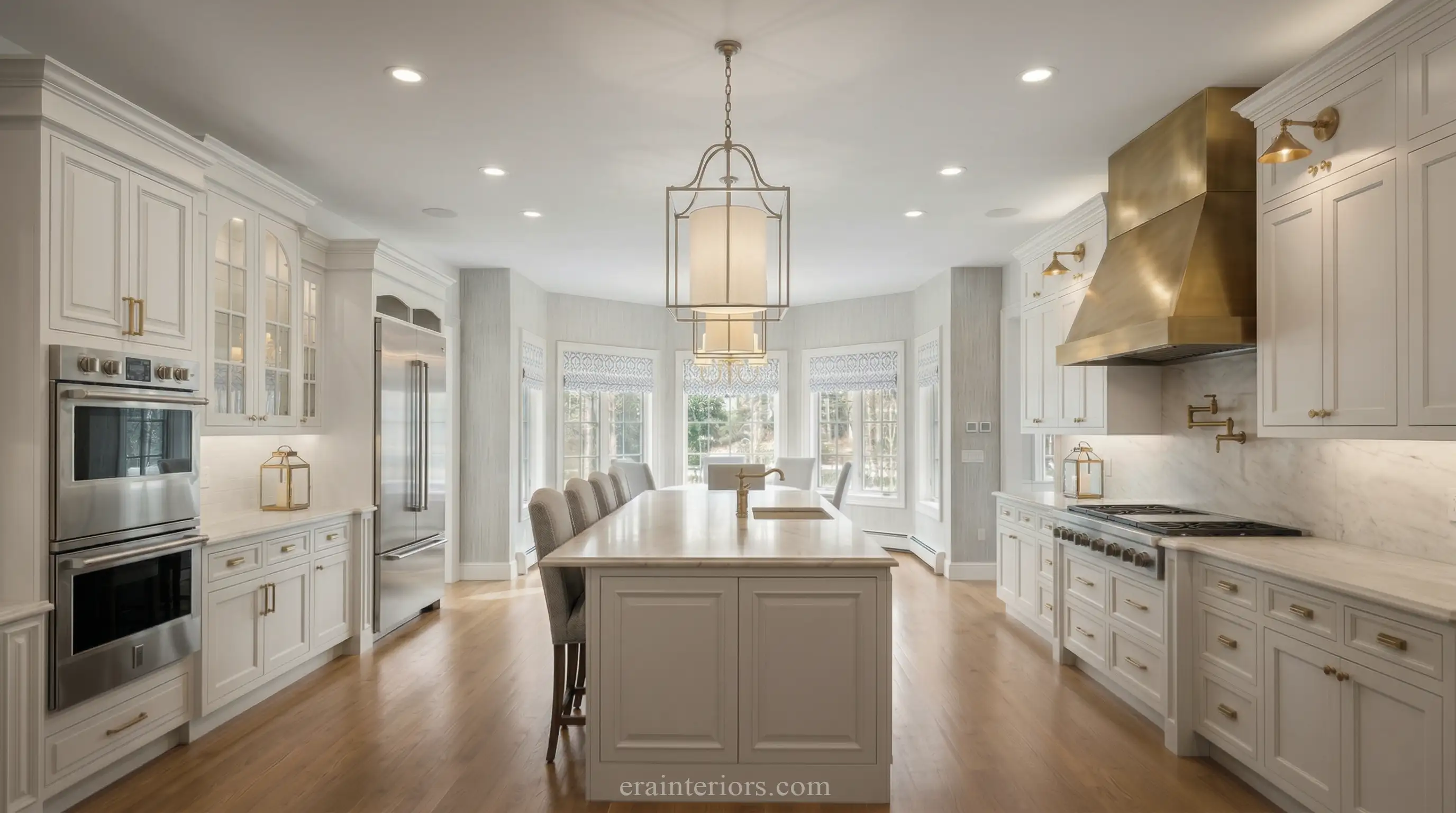
The kitchen programs we execute in Bergen County, Monmouth County, and Westchester share a set of conditions that Manhattan kitchens rarely present — scale, ceiling height, and the expectation of permanence. A 400-square-foot kitchen in a Colts Neck estate or a Saddle River renovation is a different specification problem than a Manhattan galley, and it rewards a different approach. The same applies to kitchen programs in Alpine, Rumson, and the larger estates along the Westchester waterfront — the specification logic is consistent even when the architectural character of each house is entirely different.
**Scale changes the specification**
Manhattan kitchen programs are often governed by constraint. The service elevator is 7'6" tall and 4'8" wide. The alteration agreement allows work between 8am and 5pm Monday through Friday. Every unit must be designed to split for delivery and reassemble on-site. The millwork intelligence is in solving the constraint elegantly.
Suburban estate kitchens present the inverse problem. The room is large enough to do anything. The ceiling is 10 or 12 feet. There is a mudroom, a butler's pantry, a breakfast room, and a catering kitchen to consider alongside the main kitchen. The challenge is not solving constraints — it is making decisions that produce a coherent result at scale rather than a kitchen that simply fills the room.
Proportional scale calibration is the primary specification tool. Upper cabinet heights, island dimensions, crown profile scales, and countertop overhangs that read correctly in a standard 9-foot ceiling room will read as undersized in a 12-foot kitchen. We recalculate proportional relationships for each project rather than applying standard dimensions.
**The butler's pantry is not optional**
In our experience, every serious kitchen program at this scale includes a butler's pantry. The pantry is where the operational logic of the kitchen lives — appliance storage, prep backup, secondary refrigeration, wine storage, and the service equipment that does not belong in the primary kitchen sightline. A kitchen designed without a pantry pushes all of that into the main kitchen, where it competes visually with the primary program.
The pantry is also where the material language of the kitchen is tested. A pantry that uses the same cabinet profile, the same hardware, and the same finish as the kitchen reads as a single program. A pantry that was specified separately, even with good intentions, reads as a separate room.
**The installation logistics favor longer programs**
Unlike Manhattan projects, suburban estate installations are not governed by co-op alteration agreements or service elevator windows. This creates an opportunity for more coherent installation phasing. We can run a full kitchen and pantry installation across a single uninterrupted window rather than three phased co-op-compliant visits. The quality of the installed result benefits from this — joints are fitted in sequence rather than revisited, site conditions are consistent throughout.
For architects and homeowners working on estate kitchen programs in New Jersey — Bergen County, Monmouth County, Somerset County — Westchester, Greenwich, and coastal Connecticut, we are glad to discuss scope and approach. Our Construction & Joinery and Materials Specification collections document the fabrication standards we hold regardless of geography. The Buildings & Projects collection includes an estate kitchen program in Westchester that illustrates the full compound scope these commissions typically involve.
Related: Millwork for Hamptons and Coastal Estate Properties · Specifying Millwork for Pre-War New York Apartments · Spatial Systems