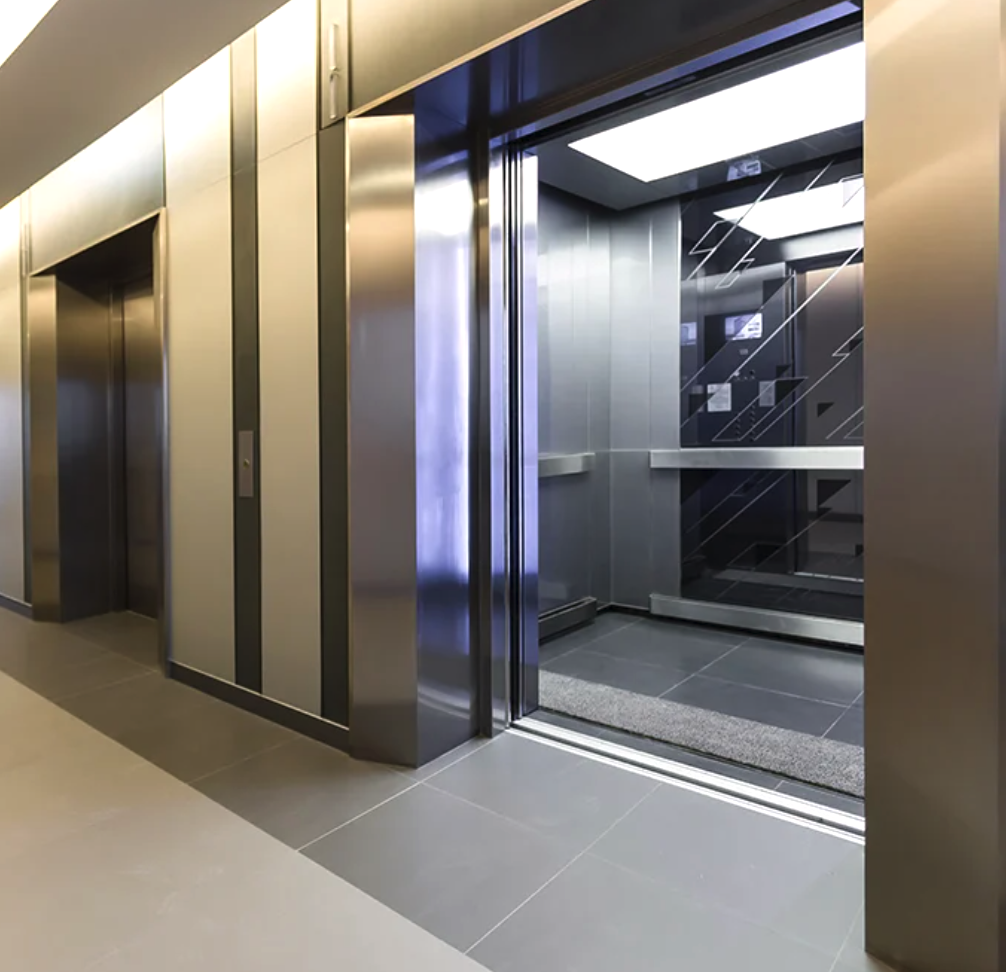
In a Manhattan co-op or condo, the service elevator is not a delivery detail. It is a design constraint that governs how every piece of millwork in the building is fabricated. A millwork shop that does not measure the service elevator before writing the shop drawings will produce units that cannot be delivered. This happens more often than it should.
**The dimensions that matter**
Service elevator dimensions vary by building and by era of construction. In a typical pre-war co-op, the cab is approximately 7'6" to 8' tall, 4'6" to 5' wide, and 5' to 6' deep. Post-war buildings tend to have larger cabs. Glass tower buildings often have modern freight elevators with 10'+ clear height. The height is the critical dimension — it governs the maximum deliverable length of any vertical component, including floor-to-ceiling panels, tall cabinet units, and library case sections.
Width is the secondary constraint. A panel that fits the elevator height may still be too wide to enter the cab at the angle required for the building's elevator lobby geometry. We verify both dimensions on every project, and we verify the lobby turning radius at the same time.
**What break-point engineering actually means**
Break-point engineering is the fabrication technique that resolves the conflict between the desired unit height and the elevator height limit. A floor-to-ceiling cabinet in a 10-foot room cannot be delivered as a single unit if the elevator is 7'6". The solution is to design the unit as two sections — a lower case and an upper case — that join at a designed joint.
The word "designed" is important. A break-point joint that is an afterthought will show in the finished work — a horizontal line at an arbitrary height, inconsistent with the profile logic of the unit. A break-point joint that is designed from the beginning is concealed by a profile detail — typically a shadow gap, a moulding profile, or a panel transition — that reads as a deliberate element of the piece rather than an accommodation.
In our pre-war kitchen programs, every tall unit is designed with a break point at the crown rail. The joint is behind the crown profile; the assembled unit shows no horizontal interruption. In library programs, break points are placed at shelf heights — the case sections are assembled on-site at a shelf, and the joint is concealed by the shelf front.
**The alteration agreement adds another layer**
Service elevator access is typically scheduled through the building superintendent within the hours permitted by the alteration agreement — usually 8am to 5pm, Monday through Friday. In some buildings, elevator use must be reserved days in advance. A delivery that arrives outside the permitted window, or without a reserved elevator, will sit in the lobby.
We build elevator access into every Manhattan installation schedule. For multi-phase projects — a kitchen in the first phase, a library in the second — we coordinate the delivery schedule with the super at the start of the project, not the day before delivery.
The service elevator is not a logistics problem. It is a specification parameter, and it belongs in the drawings from the first sheet.
Our Spatial Systems collection covers NYC building typologies and the constraints each presents. The Construction & Joinery collection covers break-point engineering and the joinery methods that make it invisible.
Related: Specifying Millwork for Pre-War New York Apartments · Pre-War Buildings Have Their Own Logic · Working With Architects on New York Residential Renovations