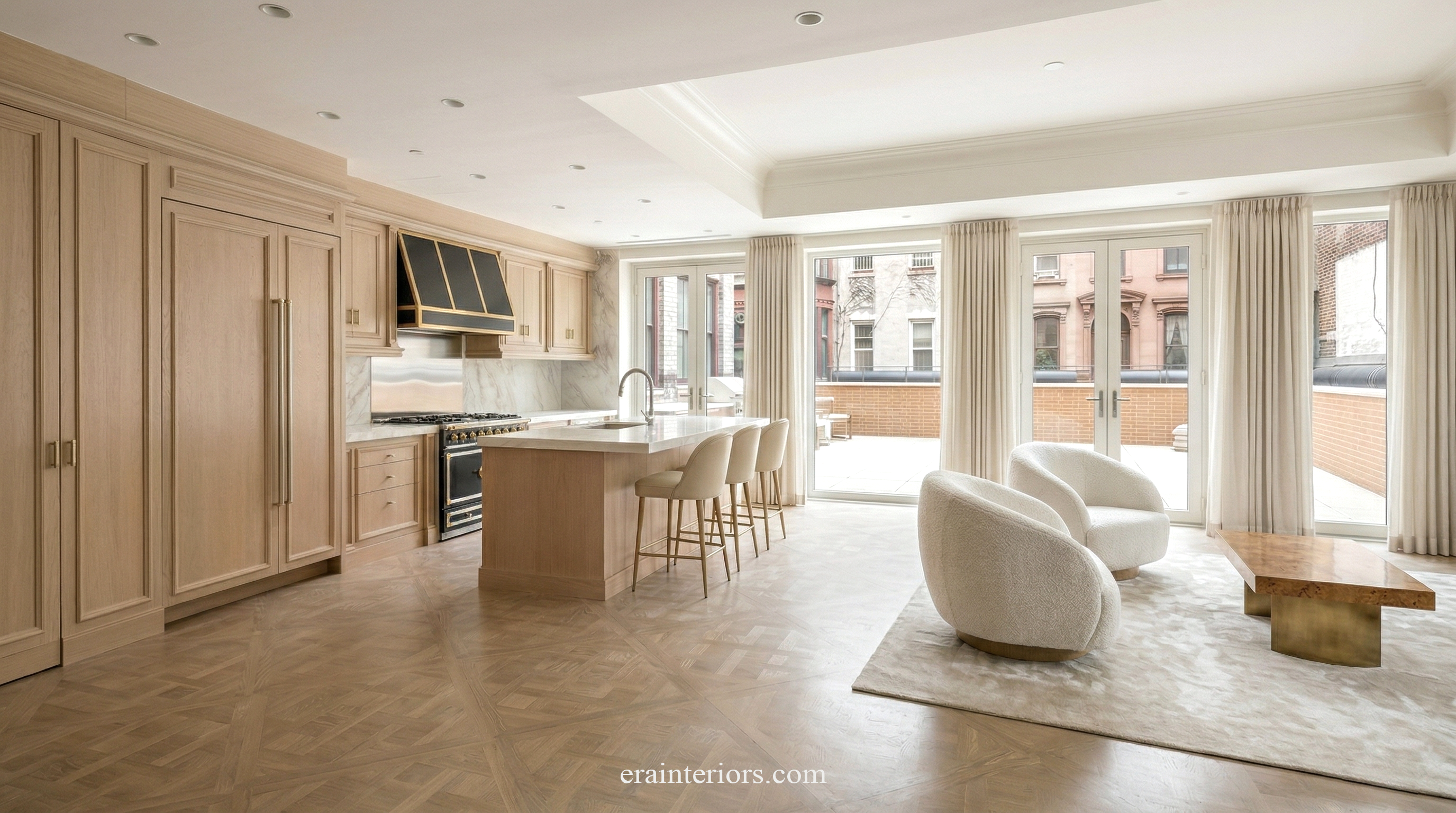
The relationship between a millwork atelier and the architect of record on a residential renovation is not a vendor relationship. It is a technical collaboration — and the quality of that collaboration shows in the finished work. In our experience, the projects that produce the best results are those where the architect engages the millwork fabricator early, shares the full drawing set, and treats the millwork specification as a design conversation rather than a procurement exercise.
**What architects need from a millwork fabricator**
Architects working on residential renovations in New York need a millwork fabricator who can read a set of drawings, identify specification problems before they reach the shop, and contribute to the resolution of those problems in a way that serves the design intent. They do not need a fabricator who executes exactly what is on the drawings without comment, produces a result that meets the drawing but not the intent, and then charges for changes.
The problems we catch most often in an architect's millwork drawings are: ceiling height conflicts with upper cabinet dimensions, elevator access constraints that will require break-point engineering not indicated on the drawings, profile details that reference stock patterns no longer available, and hardware specifications that conflict with the construction method. Identifying these before fabrication begins saves schedule, money, and the friction that attends a change order discovered in the field.
**The alteration agreement is a design constraint**
Every significant renovation in a Manhattan co-op or condo is governed by an alteration agreement. The alteration agreement specifies work hours, elevator access windows, noise restrictions, and dust containment requirements. For a millwork fabricator, the critical variables are service elevator dimensions and the daily work window.
We build the alteration agreement into the fabrication specification from the first drawing. Units are designed to their maximum deliverable dimension — typically 84" for standard co-op service elevators, though we verify each building individually. Break-point engineering is not a field accommodation; it is a designed feature, with the joint concealed by a profile detail that is part of the original drawing.
**When the millwork is also the soft furnishings**
On renovations where we are providing both millwork and soft furnishings, the architect has a single point of contact for the full interior program. The material decisions — species, finish, hardware, fabric palette, drapery heading — are made in a single specification conversation rather than across multiple vendor relationships. The architect's design intent is preserved more completely when the people executing it are working from the same specification document.
This is the compound program model. Our Buildings & Projects collection documents several renovations executed this way. The Soft Furnishings Projects collection documents the soft furnishings side of the same work.
For architects working on residential renovations in Manhattan, Brooklyn, Westchester, the Hudson Valley, northern New Jersey — including Bergen and Monmouth counties — and coastal Connecticut, we are glad to discuss scope and approach at any stage of the design process. For estate commissions in the Hamptons and along the Connecticut shore, we travel for both installation and pre-specification site visits.
Related: Pre-War Buildings Have Their Own Logic · The Service Elevator Is Part of the Specification · Specifying Millwork for Pre-War New York Apartments